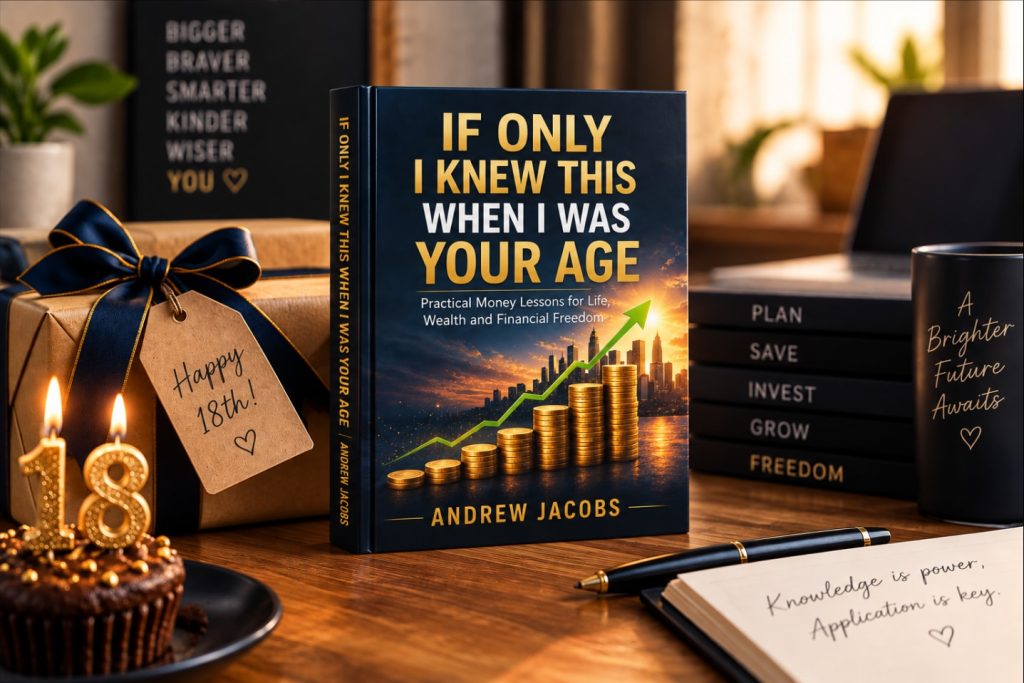
Turning eighteen is one of those birthdays that feels different.
You’re no longer buying a gift for a child. You’re buying something for a young adult who is about to start making some very adult decisions — earning money, opening accounts, using credit, buying a car, studying, working and, hopefully, beginning to build a future.
Most 18th birthday gifts are eventually forgotten. The clothes get worn out. Technology gets replaced. The cash gets spent.
But what if part of your gift could still be influencing the decisions they make at 25, 30 or even 40?
That’s what makes financial education such a meaningful financial gift for an 18th birthday. It isn’t about telling a young person what to do with their money. It’s about giving them knowledge before they have to learn every lesson through experience.
I know that because many of the lessons in If Only I Knew This When I Was Your Age are lessons I learned exactly that way — by getting things wrong first.
And that’s really where the book came from. Not from believing I have all the answers, but from thinking: if only someone had explained some of this to me when I was younger.
Why Financial Literacy Makes a Meaningful 18th Birthday Gift
Eighteen Brings Financial Decisions Very Quickly
Finishing school doesn’t automatically prepare someone for the financial decisions that follow.
For some young adults, the next step will be university or college. Others will start working, take a gap year or begin trying to build something of their own.
Whichever path they choose, money suddenly becomes very real.
There may be a first salary. A first credit application. A first vehicle. A cellphone contract. Rent. Insurance. Bank fees. Savings decisions.
And there will certainly be plenty of opportunities to spend.
The difficulty is that some financial mistakes made when you’re young can follow you for years. Nobody deliberately sets out to become trapped by debt or live from payday to payday. It usually happens one seemingly affordable decision at a time.
A little financial knowledge before those decisions begin can make an enormous difference.
Give Something That Can Grow in Value
There’s nothing wrong with giving an 18-year-old something they simply want. Birthdays are meant to be enjoyed.
But perhaps the answer doesn’t have to be either a fun gift or something meaningful.
It can be both.
Give them the headphones, shoes, cash or whatever else will make their day — and perhaps add something that might make a difference to their future too.
A book won’t be the most exciting package on the table.
But it might be the one they remember years later.
What Money Skills Should an 18-Year-Old Learn?
Financial literacy doesn’t mean an eighteen-year-old needs to understand every investment product, tax rule or economic theory.
Far from it.
Some of the most important lessons are remarkably simple.
Learn Where Your Money Goes
One of the first skills any young adult can learn is to understand their own cash flow.
How much money is coming in?
Where is it going?
How much disappears on things that seemed insignificant at the time?
Budgeting isn’t about never enjoying your money. It’s about making conscious choices instead of reaching the end of the month wondering where everything went.
That’s why I’ve made a free Budget Planner and other financial tools available on the website. They give young people somewhere practical to start applying these ideas.
Understand Debt Before Using It
Credit can make something feel affordable because it changes the question from:
“How much does this cost?”
to:
“Can I afford the monthly payment?”
Those are not the same question.
Understanding interest, repayment periods and the real cost of borrowing before signing that first agreement is an incredibly valuable lesson.
Young adults don’t need to fear all debt. They need to understand what they’re agreeing to and what today’s purchase may cost their future self.
Understand the Power of Starting Early
At eighteen, time is one of your greatest financial assets.
You may not have much money yet, but you have something a forty-year-old cannot buy back: decades.
Understanding compound growth early can completely change how someone thinks about saving and investing. Small amounts may not look impressive initially, but time can do much of the heavy lifting.
The lesson isn’t get rich quickly.
It’s almost the opposite.
Start small. Start early. Keep going.
Don’t Let Every Increase Become an Upgrade
Eventually the first salary becomes a better salary.
That’s when another danger appears.
A better car. Better clothes. More expensive nights out. A bigger cellphone contract. More subscriptions.
There’s nothing wrong with enjoying the rewards of hard work. The problem starts when every increase in income automatically creates an increase in expenses.
We’ve written more about exactly this in our article on lifestyle creep because it’s one of the easiest financial traps to fall into without even noticing.
A Financial Book Should Feel Like a Conversation, Not a Lecture
Young adults are remarkably good at detecting a lecture.
Give someone an 18th birthday present that effectively says “Here, you clearly need to learn how to manage your money” and there’s a fair chance it will remain unopened.
The way financial education is presented matters.
That was important to me when writing If Only I Knew This When I Was Your Age.
I didn’t want to write a textbook, and I certainly didn’t want to pretend to be a financial expert.
I wanted it to feel more like sitting down with someone older who says:
“I’ve been down this road. I got some things right. I got plenty wrong. Here are a few things I wish somebody had explained to me before I started.”
That’s a very different conversation.
You can If Only I Knew This When I Was Your Age to get a better feel for the approach before deciding whether it’s right for the young person you’re buying for.
Turn the Book Into More Than Just a Gift
This is where I think a financial literacy book can become something genuinely special.
Don’t just wrap it.
Make it personal.
Write Something Inside the Cover
Write a short message explaining why you’re giving it to them.
It doesn’t have to be profound.
Something as simple as:
“I don’t expect you to have life figured out at eighteen. None of us did. I hope something in these pages helps you make one or two decisions a little earlier than I did.”
Suddenly it isn’t merely a book.
It becomes a message from a parent, grandparent, aunt, uncle, godparent, family friend or mentor who genuinely wants the best for them.
And years from now, that handwritten note may mean more than the book itself.
Share One of Your Own Money Mistakes
You don’t need to give them your entire financial history.
Just be human.
Perhaps you bought something you couldn’t really afford. Maybe you started saving too late. Perhaps you wasted your first salary or learned the hard way how expensive debt could become.
Sharing one of those stories changes the conversation.
Instead of:
“Here’s what you should do.”
It becomes:
“Here’s something I learned.”
There’s far less judgement in that.
Have the Conversation — Then Let Them Decide
Give them the book and leave the door open.
If something in it makes them curious, talk about it.
If they disagree with something, talk about that too.
Financial education should give young adults better information with which to make their own decisions. It shouldn’t make those decisions for them.
Sometimes the best thing a parent or mentor can do is start the conversation and then get out of the way.
A Gift for an 18-Year-Old That May Still Matter at 28
I can’t promise that giving an eighteen-year-old a financial literacy book will make them wealthy.
It won’t guarantee that they’ll never get into debt, overspend or make a terrible financial decision.
They probably will make mistakes.
We all do.
But perhaps they’ll recognise one mistake a little earlier.
Perhaps they’ll think twice before taking on debt they don’t understand.
Perhaps they’ll start putting away a small amount from their first salary.
Perhaps they’ll understand the value of time and compounding before another ten years disappear.
Or perhaps the book sits on a shelf for two years before something happens in their life that makes them pick it up again.
That’s okay too.
The purpose isn’t to create a financial expert at eighteen.
It’s simply to put some knowledge in their hands before experience has to teach them every lesson the expensive way.
That’s ultimately what If Only I Knew This When I Was Your Age is about.
At eighteen, nobody needs another adult telling them they know better.
Sometimes they simply need someone to put a little knowledge in their hands and allow them to decide what they do with it.
Knowledge is power.
Application is key.