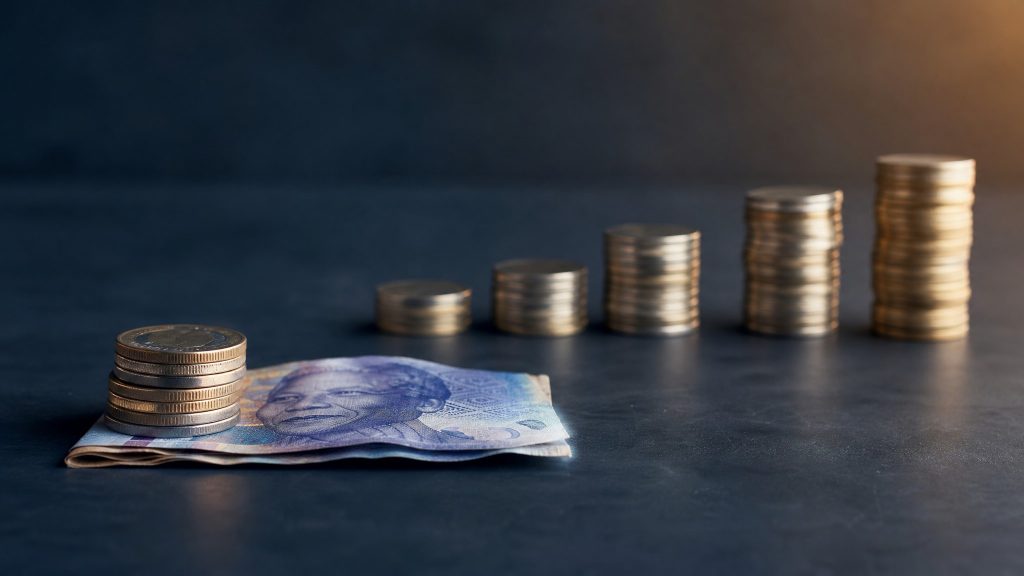
For many young South Africans, investing feels like something you do once you’ve earned a good salary, bought a house or reached a certain level of financial security.
But does investing really require thousands of rands?
Not necessarily.
Learning how to start investing with R500 a month in South Africa can be a useful way to understand how investing works, even if you’re not financially ready to begin just yet.
The important lesson isn’t that everyone should invest R500 every month.
It’s that building wealth is often less about how much money you start with and more about understanding your options, developing good financial habits and giving your money time to grow.
Before investing anything, however, it’s worth understanding the difference between saving and investing, the risks involved and whether your finances are ready for that next step.
Is R500 Enough to Start Investing in South Africa?
R500 might not sound like much when you’re thinking about building long-term wealth.
But some investment platforms and financial products allow people to begin with relatively small amounts.
This means investing isn’t necessarily reserved for people with large salaries or substantial savings.
However, being able to invest R500 and being able to afford to invest R500 are two very different things.
If your monthly income barely covers your essential expenses, or you’re struggling with expensive debt, investing may not be your immediate priority.
For someone else, R500 might be a manageable amount to set aside regularly.
The right starting amount depends on your financial circumstances, not on a number suggested in an article.
Why Starting Small Can Still Be Valuable
One of the biggest advantages of starting with a manageable amount is the opportunity to develop financial discipline.
Regularly setting money aside encourages you to think beyond your next payday.
It also gives you an opportunity to learn about investment products, fees, market movements and long-term financial planning.
But remember that investments can rise and fall in value.
Contributing regularly doesn’t guarantee a profit, and starting earlier doesn’t remove investment risk.
The real benefit is learning how to make informed financial decisions that support your long-term goals.
Understand the Difference Between Saving and Investing
Saving and investing are often discussed together, but they serve different purposes.
Saving generally involves putting money aside for future expenses or emergencies, usually in a product designed to preserve capital and provide access to your money.
Investing involves placing money into assets or financial products with the aim of generating returns over time.
Those returns might come from interest, dividends or increases in the value of an investment.
But unlike ordinary savings, some investments can experience significant fluctuations in value.
When Saving May Be More Appropriate
Imagine you’re putting money aside for a car repair, an upcoming course or an emergency expense.
You may need that money within the next few months.
In this situation, protecting your capital and having access to it may be more important than pursuing higher potential returns.
This is one reason emergency savings are such an important part of financial planning.
An unexpected expense shouldn’t automatically force you to sell an investment at a loss or borrow money at high interest rates.
When Investing May Become Relevant
Investing is generally associated with longer-term financial goals.
These might include building wealth over many years, preparing for retirement or working towards future financial independence.
Longer time horizons may give investors more opportunity to recover from market fluctuations, although recovery is never guaranteed.
Before choosing an investment, it’s important to understand when you’ll need the money and how much uncertainty you can reasonably accept.
What Could R500 a Month Grow Into?
One of the most interesting concepts in personal finance is compound growth.
Compounding happens when returns remain invested and may begin generating additional returns of their own.
Over long periods, this can have a significant effect on the value of an investment.
Let’s look at a hypothetical example.
Imagine someone invests R500 every month for 20 years.
Over that period, their total contributions would be:
R500 × 12 months × 20 years = R120,000
Now imagine the investment achieves a hypothetical average annual return of 7%, with growth compounded monthly.
Under those assumptions, the investment could grow to approximately R260,000 over 20 years.
That would include the original R120,000 in contributions plus approximately R140,000 in investment growth.
This is an illustration, not a prediction.
Actual investment returns vary, markets can experience prolonged declines, and fees, taxes and inflation can materially affect the outcome.
The example also assumes regular contributions and a constant hypothetical return, whereas real markets do not grow smoothly every month.
Why Time Matters
The longer money remains invested, the more opportunity there may be for compound growth.
But time alone doesn’t guarantee a positive result.
Different investments carry different risks, and the value of an investment may be lower when you need to withdraw it.
The important lesson is to understand how time, contributions, returns and risk interact.
You can experiment with different monthly contributions, investment periods and hypothetical returns using our free Compound Interest Calculator.
Try changing the numbers and see how the results differ.
It’s a useful educational exercise, even if you’re not ready to invest.
Understand Your Financial Position Before Investing
Before thinking about investment products, it’s worth looking at your existing financial foundation.
Do you know where your money goes every month?
Are your essential expenses covered?
Do you have access to money for unexpected expenses?
Are you paying high interest rates on outstanding debt?
These questions matter because investing shouldn’t create additional financial pressure.
Start With a Realistic Budget
A budget helps you understand what you earn, what you spend and what might be available for your future.
It also helps distinguish between money that is genuinely available and money that may be needed for upcoming expenses.
If you’re still working on this foundation, read our guide on how to budget on a small salary in South Africa.
There’s no benefit in committing money to an investment if doing so leaves you unable to cover essential expenses.
Consider the Cost of Existing Debt
Debt is another important consideration.
Some forms of borrowing carry interest rates that can place significant pressure on a monthly budget.
Investment returns, on the other hand, are generally uncertain.
That doesn’t mean every person must become completely debt-free before investing.
It means the cost, terms and affordability of existing debt deserve careful consideration when making financial decisions.
Our article on how to avoid the debt trap in South Africa explores this in more detail.
Understanding Common Investment Options in South Africa
Once you understand your financial position, the next step is learning about the investment products available.
Three terms you’re likely to encounter are:
- Exchange-Traded Funds (ETFs)
- Unit trusts
- Tax-Free Savings Accounts (TFSAs)
These are not all the same type of product, and understanding the differences is important.
What Is an Exchange-Traded Fund (ETF)?
An Exchange-Traded Fund is an investment fund that trades on a stock exchange.
Many ETFs track a particular market index, such as a collection of shares from companies listed on an exchange.
Rather than purchasing shares in individual companies, an investor can gain exposure to a group of investments through one fund.
For example, an ETF tracking a broad share-market index may hold shares in numerous companies.
This can provide diversification, although the level of diversification depends on the fund itself.
Diversification can reduce certain risks, but it cannot eliminate the possibility of losing money.
ETFs may also charge management fees, platform fees or transaction costs.
Not every ETF is suitable for every investor, and some focus on narrow sectors or specialised strategies that can carry substantial risk.
What Is a Unit Trust?
A unit trust pools money from investors and invests it according to a defined strategy.
Depending on the fund, the underlying investments might include shares, bonds, cash or a combination of assets.
Some funds are actively managed, while others follow an index or rules-based approach.
Unit trusts can have different risk levels, investment objectives, fees and withdrawal arrangements.
A unit trust investing mainly in shares behaves very differently from one investing primarily in money-market instruments.
That’s why understanding the underlying assets is more important than simply recognising the product name.
What Is a Tax-Free Savings Account (TFSA)?
A Tax-Free Savings Account is a South African tax-advantaged savings and investment arrangement.
Despite the name, a TFSA doesn’t necessarily mean your money is held in an ordinary savings account.
Depending on the provider and product, a TFSA may hold investments such as qualifying funds or other permitted assets.
Under the applicable South African rules, qualifying returns within a TFSA are generally exempt from income tax, dividends tax and capital gains tax.
However, TFSAs have annual and lifetime contribution limits.
Contributing more than the permitted limits can result in significant tax penalties.
Withdrawals also don’t restore the contribution allowance you’ve already used.
For example, withdrawing money from a TFSA doesn’t mean you can simply replace that amount without it counting towards your contribution limits.
The applicable limits and rules can change, so it’s important to check the latest information directly with the South African Revenue Service before making decisions.
A TFSA’s tax advantages don’t guarantee investment growth or protect the underlying investment from market losses.
Why Investment Fees Matter
One aspect of investing that beginners sometimes overlook is cost.
Investment products and platforms may charge different types of fees.
These can include:
- Platform or administration fees
- Fund management fees
- Transaction fees
- Financial advice fees
- Other product-specific charges
Fees reduce the amount of money that remains invested or the return an investor ultimately receives.
This can become particularly noticeable when investing smaller amounts.
For example, a fixed transaction fee of R25 represents 5% of a R500 contribution.
That doesn’t automatically mean a product is unsuitable, but it demonstrates why understanding the full cost structure matters.
Over long periods, recurring fees can also affect compound growth.
Before choosing any investment product, understand what it costs, how the charges are calculated and whether there are additional conditions or penalties.
What Happens When Investment Markets Fall?
One of the realities of investing is that markets don’t move upwards in a straight line.
There will be periods when investments increase in value.
There may also be periods when they decline, sometimes substantially.
For someone investing for the first time, watching the value of an investment fall can be uncomfortable.
This is why understanding risk before investing is so important.
Market Volatility Is Not the Same as Guaranteed Recovery
You may hear people say that markets always recover.
While some broad markets have recovered from significant historical downturns, that doesn’t mean every investment will recover or that recovery will happen within your required timeframe.
Individual companies can fail.
Certain sectors can experience prolonged difficulties.
And even diversified investments can suffer losses.
Your investment timeframe, financial circumstances and ability to tolerate fluctuations all influence whether a particular type of investment may be appropriate.
Be Careful With Investment Trends
Social media can make investing look remarkably easy.
A successful investor might share impressive returns without showing the losses, risks or circumstances behind them.
Cryptocurrency trends, individual shares and fashionable investment products can generate excitement, but popularity doesn’t establish suitability or safety.
Before considering any investment opportunity, ask whether you understand what you’re buying, what could go wrong and how the provider makes money.
Be particularly cautious of promises of guaranteed high returns or pressure to act immediately.
If you don’t understand an investment, there’s nothing wrong with taking more time to learn.
Questions to Ask Before Choosing an Investment
Rather than rushing to open an account, consider what you need to understand first.
What Am I Investing For?
Is your goal five years away, twenty years away or even further into the future?
Different timeframes may call for different approaches.
When Might I Need the Money?
An investment that fluctuates significantly in value may be inappropriate for money needed at short notice.
Understanding access and withdrawal conditions is important.
What Are the Risks?
Find out whether your capital can decline, how the investment has behaved during difficult market conditions and what factors affect its value.
Past performance doesn’t guarantee future results.
What Will It Cost?
Understand the total fees, not just the headline management charge.
Is the Provider Legitimate?
Check who operates the platform, which regulated entities are involved and whether any required authorisations can be verified through the appropriate South African regulators.
Where relevant, the Financial Sector Conduct Authority is an important starting point.
These questions are more valuable than choosing an investment simply because someone on social media recommended it.
Building Good Financial Habits Before Your First Investment
You don’t need to open an investment account tomorrow to start improving your financial future.
There are useful steps you can take before investing your first rand.
Start by understanding your monthly income and expenses.
Learn how interest, inflation and compound growth work.
Build awareness of the costs and risks associated with different financial products.
Think about your financial goals and when you may need access to your money.
And keep learning.
Financial knowledge is something you can develop gradually.
You don’t have to understand every investment product immediately, and you certainly don’t need to make decisions simply because other people appear to be further ahead.
Frequently Asked Questions
Can I Really Start Investing With R100 or R500 a Month?
Some South African investment products and platforms accommodate relatively small contributions.
However, minimum investment amounts, fees and available products differ between providers.
Whether R100 or R500 is an appropriate contribution depends on your budget, financial responsibilities and goals.
The ability to invest a particular amount doesn’t automatically mean you should.
Is Investing the Same as Saving?
No.
Saving generally focuses on setting money aside, often with an emphasis on capital preservation and accessibility.
Investing involves exposure to assets or products that may generate returns but can also experience losses.
The distinction depends on the underlying product, not simply what the account is called.
Is an ETF Better Than a Unit Trust?
Not necessarily.
An ETF and a unit trust are different fund structures, and their suitability depends on the underlying investments, fees, risk characteristics and an individual’s circumstances.
Neither is automatically the better choice for everyone.
Is a TFSA a Good Place to Start?
A TFSA offers tax advantages under South African legislation, but whether it is appropriate depends on factors such as your investment timeframe, access requirements and financial circumstances.
It’s also important to understand the contribution limits and consequences of withdrawals.
Can I Lose Money Investing R500 a Month?
Yes.
Investments can lose value regardless of the amount contributed.
Making regular contributions doesn’t eliminate market risk or guarantee a positive return.
Should I Pay Off Debt Before Investing?
There isn’t one answer that applies to everyone.
The interest rate, terms and affordability of your debt, your emergency savings and your financial goals all matter.
If you’re unsure how to balance competing priorities, consider discussing your circumstances with an appropriately qualified financial professional.
Start With Knowledge, Not Pressure
The biggest lesson isn’t that every young South African should immediately start investing R500 a month.
It’s that you don’t need to be wealthy to begin understanding how wealth is built.
You can learn about investment products before you buy them.
You can explore compound growth before you commit money.
You can build a budget, understand your debt and start developing financial habits that support your future.
And when the time comes to make investment decisions, you’ll be better equipped to understand the choices available.
If you’d like to explore these principles further, If Only I Knew This When I Was Your Age was written to help young South Africans develop practical knowledge about money, business and life.
Because building a better financial future starts with understanding the decisions you make today.
Knowledge is power, application is key.
Disclaimer: This article is provided for general financial education and information only. It does not constitute personal financial, investment, tax or legal advice, nor does it recommend any particular financial product or investment strategy. Investment values can rise or fall, and returns are not guaranteed. Financial products, regulations and tax rules may change. Consider your individual circumstances and seek advice from an appropriately qualified or authorised professional where appropriate.